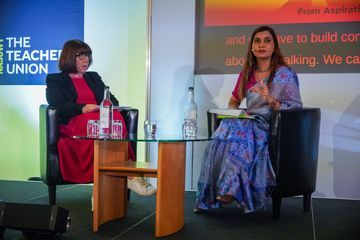
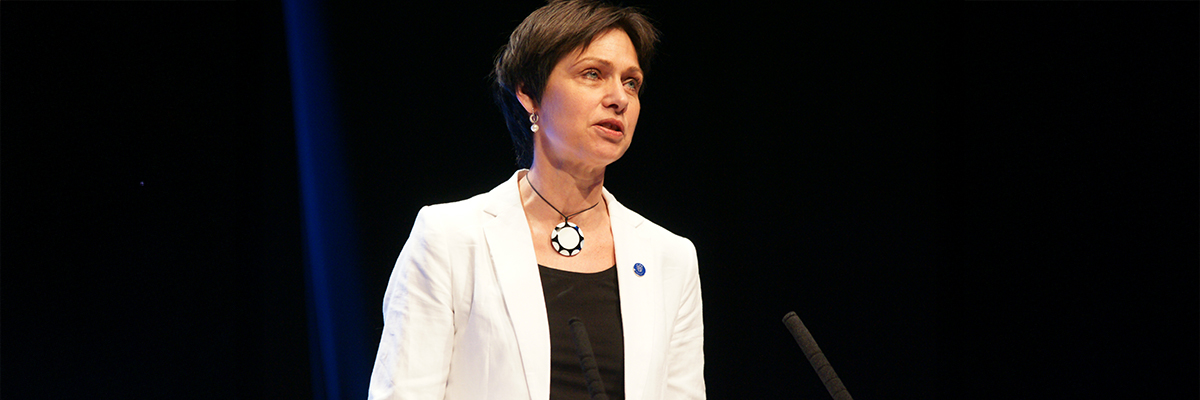
From a small Arctic fishing village to the leadership of Education International, Haldis Holst’s path has been shaped by the belief that teachers are stronger together.
Båtsfjord, a remote community perched on Norway’s northern coast was remote, cold, and short of qualified teachers and was where she discovered the power of collective strength as a young teacher.
“We depended on each other. We were very much on the front line of pushing for teamwork not individualism. But that belief has stayed with me throughout my career, both as a teacher and as a trade unionist, she said.
Her early years teaching coincided with a major curriculum reform. But instead of imposing change from above, the authorities invested in teachers:
“They reduced teaching time by one lesson a week so we had time to work on the new curriculum.
“And they trained principals and union reps together. That gave me a voice. Being listened to, not always agreed with, but listened to was empowering. When you’re given a voice, you’re willing to go the extra mile.
“When you’re silenced or side-lined, that’s when frustration grows.”
That experience propelled her into union activism, first locally, then internationally. A mission to Nicaragua opened her eyes to the global nature of teachers’ struggles:
“It changed me, not because I wanted to ‘do good’, but because I realised we had something to learn from them, and they had something to learn from us.”
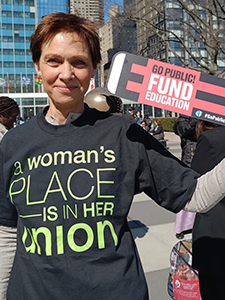
From there, her activism took her through her Norwegian teaching union to go on to become Norway’s representative to the ETUCE, a seat on the EI Executive Board, European Vice President, and finally Deputy General Secretary of Education International — a role she held for more than a decade.
At EI her responsibilities included human and trade‑union rights work that brought her into contact with some of the most courageous teachers from across the world.
One defining moment was EI’s global conference on refugees in Stockholm. Asked to moderate the event, she opened with Warsan Shire’s poem Home.
“I was so nervous,” she said. “But that poem still resonates with me. It captured everything: what it means to flee, and what it means for teachers to welcome children who have lost everything. Whether Syrian refugees in Lebanon, Ukrainian children arriving in Europe, or those crossing the Mediterranean, that’s what we do. We’re there for the children.”
A struggle singled out by Haldis as something that has affected her deeply is the situation facing trade unionists and human rights activists in Bahrain.
Mahdi Abu Dheeb, President of the Bahrain Teachers’ Association (BTA), and Vice President Jalila Al Salman have both been imprisoned and tortured for speaking out against the regime.
“Mahdi and Jalila were in prison just before I became Deputy General Secretary,” she says. “Later, I had the privilege of meeting Jalila when she was released, and then Mahdi when he was released.”
She still remembers speaking at NASUWT’s conference in Birmingham with Jalila in the room. “I said then that meeting her had changed my life,” she says. “Sometimes you need the individuals and get close to them to be able to understand the plight of the group. Jalila and Mahdi did that for me.”
Today, Jalila sits on EI’s Executive Board - but repression continues. “She still doesn’t have the right to work,” Holst notes. “At our last Executive Board meeting in December, she was detained in transit and sent back to Bahrain. She wasn’t allowed to come to Brussels.”
Haldis recently wrote to ask how she was coping with the instability in the region. Jalila’s reply was stark: “Please pray for us. This is difficult.”
But Bahrain is only one example of a wider challenge that weighs heavily.
“These plights live with me and it’s something I’ve been very concerned with that we try to strike the balance of being there when new crises start, but not forgetting the ones that still exist.”
“There has been no focus on Bahrain for a very long time, but we mustn’t forget. We mustn’t forget Afghanistan, even if we moved our focus. We won’t forget Ukraine, but we quickly moved to Palestine, of course, which is very important — and it is terrible what’s going on there. But then, have we forgotten South Sudan? Have we forgotten Myanmar?”
“How can we distribute our solidarity? Because so many people, like Jalila, have said the most important thing - yes, financial support can be important - but the most important is that we know that people know about us.”
Looking to threats to education she considers technology and the growth of AI: “Technology evolves so quickly that there’s not a teacher in the world that’s on top of what’s going on.
“We need public authorities to be a quality assurance. I’m not saying no to technology, but we need some kind of confidence that what we bring into the classrooms is not dangerous for our children.”
She is concerned about the erosion of human relationships. “Young people are living their lives through a screen and not through human contact.
“Norway is now considering removing digital devices from early‑years classrooms. We have to reteach students for our human relations.”
But the deeper threat, Holst believes, is the erosion of democracy.
“Public education is the backbone of democracy.
“Every time you express something on equity and minority rights, you get the ‘woke’ ball thrown at you.”
She points to the DEI attacks in the United States, the targeting of LGBTIQ members, and the marginalisation of indigenous peoples “We’re losing the diversity of culture and of equality that we had made quite a bit of strides of achieving.”
“Seeing a country like the US plummet down on the democracy index that will influence education too. It will influence our students and the thought that these kinds of involvement rules aren’t that important.”
She sees a direct line between democratic decline and the classroom. “If we lose public education as a shared space, then we’re all divided.”
She cites two documentaries that should be required viewing for teachers: Mr. Nobody vs. Putin, about indoctrination in Russian schools, and The Teachers’ Protest, about Norwegian teachers who refused to teach the Nazi curriculum.
“These stories remind us of the dangers and of the courage of our profession.”
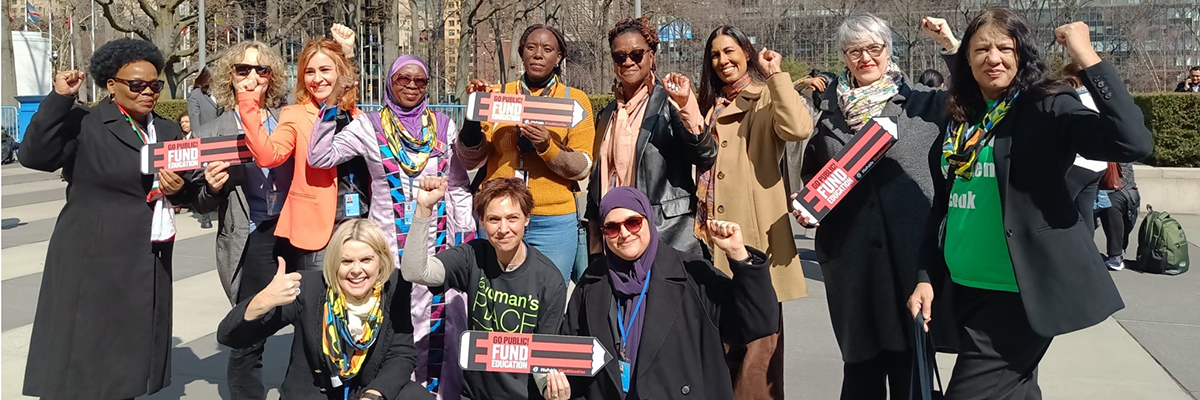
Haldis has long been a leading voice on gender equality within EI and she also praised NASUWT’s leadership on the global stage.
“First, I want to acknowledge Jennifer Moses and NASUWT for the enormous support and engagement you’ve always shown at the UN Commission on the Status of Women.
“You take part every year, and you’re very good at connecting what happens in New York with your own gender‑equality policy. That can be a role model for other member organisations.”
She also praised NASUWT Deputy General Secretary Jane Peckham, who has been central to the union’s international gender‑equality work and sees her as part of a new generation of women leaders shaping the trade union movement’s future.
But she also warned that globally more needed to be done to ensure women were in more positions of leadership in trade unions.
She said: “We are definitely in danger of a backlash in many parts of the world.
“The sense that, ‘Well, we’ve had a woman leader once, so it doesn’t matter if we go all‑male next time.’”
This year, EI’s World Women’s Conference will be women‑only for the first time. “It reflects a very real feeling that there are still places where women do not feel safe in the room. They can feel monitored, they feel controlled.”
She is careful to emphasise that this is not about excluding men. “It’s about ensuring that women have the same opportunity as men to be elected. “We must keep our level of consciousness high.”
For all her global work she recalled a story that perhaps reflects the power of teachers’ ability to change lives for the better.
She recalled: “A former student called me on Labour Day. She said she had written an op‑ed article after a boy died by suicide due to bullying. And she wrote: ‘That could have been me — but thanks to
a teacher who saw me, it wasn’t.’
“I was that teacher. I don’t know what I did. But she felt seen.”
“That is the core of what we do.”
She then told another story about a Swedish documentary, The Last Journey, in which a retired teacher hears from his former students.
“Every one of them says the same thing - he saw them. We see. We care. And we need to boost our members sometimes and tell them that they’re important. They struggle. They make a difference in so many people’s lives.”
Her advice to activists is simple: “The most important choice we can make is voice, not exit. You voice your opinions from within. You’re not afraid of disagreement. And you always believe that we’re stronger together than on our own.
“The day we lose connection with those we represent, we lose purpose. But when we see each other - truly see each other - we change lives.”