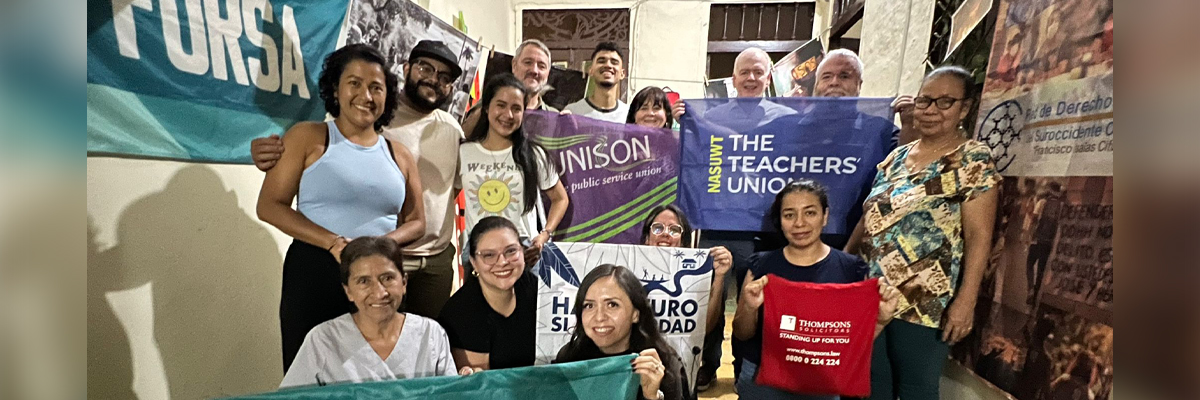
NASUWT President Wayne Broom has returned from a Justice for Colombia (JFC) delegation with a clear message: Colombia’s fragile peace process and its hard‑won reforms to workers' rights are inseparable, and international solidarity is vital to defend them.
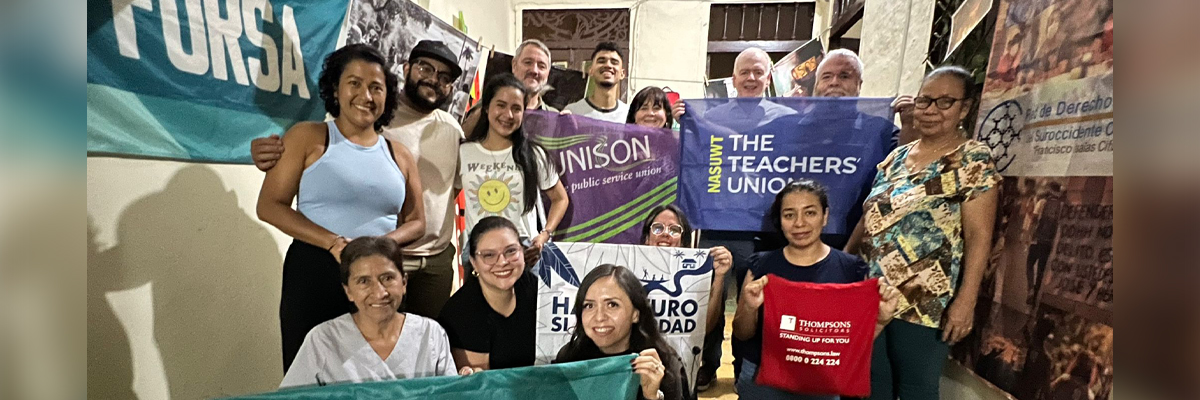
Between 6–11 November, Wayne joined 12 other senior trade union leaders from Britain and Ireland on a packed six‑day programme of meetings and travel across Bogotá, Cali, Cauca and other regions.
The delegation included TUC President Steve Gillan, TUC Assistant General Secretary Kate Bell, FORSA General Secretary Kevin Callinan, PCS General Secretary Fran Heathcote, ASLEF General Secretary Mick Whelan, NASUWT National Official Northern Ireland Justin McCamphill - who attended as he was recently President of the Irish Congress of Trade Unions (ICTU) - and representatives from UNISON, POA, FBU and Thompsons Solicitors.
Together, they met government ministers, trade unionists, human rights defenders, peasant and indigenous organisations, and victims of conflict to assess the state of Colombia’s peace process and human and trade union rights.
Delegates heard repeatedly that the 2016 peace agreement remains the blueprint for modernising Colombia’s political and economic system. Electoral reform, land redistribution, and measures to tackle inequality were all identified as essential steps.
While President Gustavo Petro’s government has invested more heavily in peace implementation than its predecessors, doubling resources and granting more land to poor rural communities, progress is still uneven and contested.
Former President Juan Manuel Santos, who signed the peace accord, and other political leaders warned that far‑right actors continue to obstruct reforms. Concerns were also raised about the destabilising impact of US policy in the region, particularly escalating tensions with Venezuela.
Wayne said: “Many people told us that Colombia needs to move away from the oligarchic model of the past towards a more democratic one. The peace agreement is the key to that modernisation. But we also heard how fragile it remains, and how determined some forces are to block it.”
Working Rights Gains and Ongoing Challenges
For Colombia’s trade unions, Petro’s labour reform has been a significant breakthrough. It restored rights stripped away under Alvaro Uribe’s 2002 legislation, including permanent contracts as standard, reduced working hours, overtime pay, protections for domestic and platform workers, and stronger safeguards against gender‑based violence.
Wayne welcomed the changes but stressed that challenges remain: “Unions told us that while the government has fulfilled its promise as far as it has been able, collective bargaining rights and restrictions on outsourcing were stripped out of the final bill. That shows how hard the opposition is working to block legislation aimed at improving workers' rights.”
The reforms have also strengthened the Labour Inspectorate, with 1,000 new inspectors hired to enforce standards. Yet unions warned that right‑wing forces in Congress continue to use ‘lawfare’ to stall reforms in the courts.
Delegates heard that pension reform, which would extend coverage to 30% of the population and lift millions out of poverty, remains stalled in Congress, alongside healthcare and education reforms. Despite these obstacles the unions noted a significant shift in relations with government, they told the delegation.
For the first time, unions are recognised as “subjects of collective reparation,” opening the door to policies that counter past stigmatisation and violence.
"This is a notable change and unions are now working together with ministries on issues from occupational safety to gender equality. That cooperation is a foundation for rebuilding trust and strengthening democracy," Wayne said.
During the visit the link between peace and workers’ rights was a recurring theme. Nearly 4,000 trade unionists were murdered between 1986 and 2016, a third of them teachers. Delegates heard that almost 500 former FARC combatants who signed the peace agreement have been killed since 2016, with many more displaced.
Wayne said: “Our partners underlined that trade union and human rights go hand in hand with peace.
“Without security for signatories, without land reform, without tackling inequality, there can be no lasting peace. Teachers and trade unionists are still being threatened, displaced, and even killed for standing up to child recruitment and violence. That is why international solidarity matters.”
The Threat from Far‑Right Actors
The delegation met with former Senator Victoria Sandino, leading peace activist Danilo Rueda, and negotiators from both government and armed groups. Many warned that far‑right actors are determined to undermine the 2016 peace agreement. Petro’s “Total Peace” policy, aimed at negotiating with new armed groups, has reduced violence in some areas but lacks a legal framework to secure lasting agreements. Critics argue it has distracted from the core task of implementing the 2016 deal.
“We were told repeatedly that the threat from far‑right actors is real. They want to roll back the peace process and block reforms. That’s why defending the implementation of the 2016 agreement during and after the elections is so critical,” Wayne said.
The human cost of Colombia’s ongoing conflict was starkly illustrated in meetings with communities in Cauca and Cali. Delegates heard of increased child recruitment and kidnapping, threats to community activists, and the forced confinement of villages. In Cauca alone, 36 human rights defenders and social leaders have been murdered this year, with hundreds of violent incidents recorded.
Indigenous groups reported that 850 children had been recruited by armed groups in their territories, while 125 teachers had been displaced due to threats and violence. Relatives of victims from the 2020–21 protest movement described trauma, exile, and ongoing legal persecution.
Wayne reflected: “The stories we heard from families of protestors and from indigenous communities were heartbreaking. Yet what struck me most was their resilience, and their determination to keep fighting for peace despite everything.”
Colombian ministries highlighted progress in reducing poverty, expanding land distribution, and
shifting drugs policy towards crop substitution. They reported reductions in killings of human rights defenders and peace signatories, and emphasised new protection measures. However, officials acknowledged that the removal of transitional justice sentences and the ethnic chapter from the UN Verification Mission’s mandate has weakened oversight.
The Constitutional Court has ordered the government to restore the institutional status of the Peace Implementation Unit, a move welcomed by the delegation.
Recommendations and Solidarity
The delegation is calling on the British and Irish governments to maintain strong international oversight of Colombia’s transitional justice system, support dialogue in conflict regions, and press for greater security and resources for peace signatories. It warns of the risks posed by regional instability and urges governments to oppose coercive interventions.
Wayne said: “Colombian unions are fighting for the same rights we value in Britain and Ireland—secure work, collective bargaining, and dignity at work. Their struggle is inseparable from the struggle for peace. By standing with them, we strengthen the global movement for workers’ rights and democracy.
“Colombia’s unions have shown extraordinary resilience in the face of violence and repression.
"Their fight for peace and justice is our fight too. We must continue to build alliances, share resources, and amplify their voices.”