
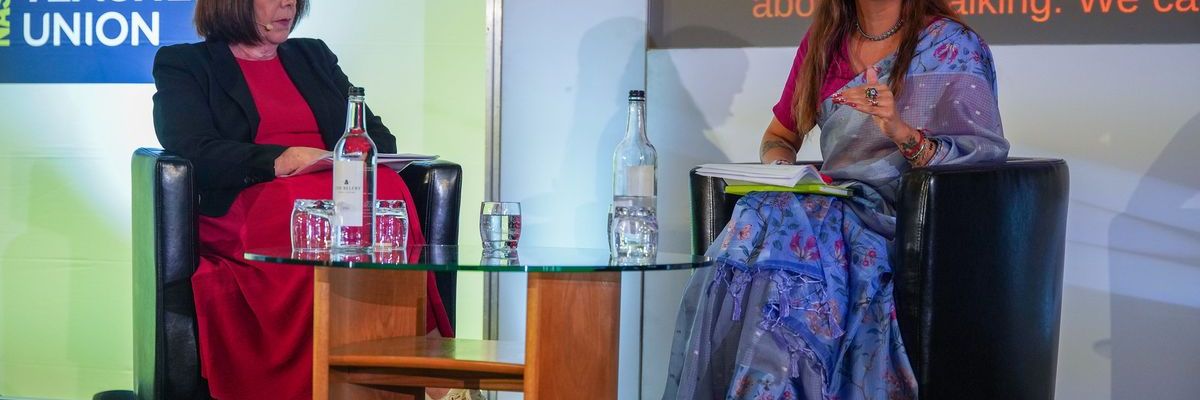
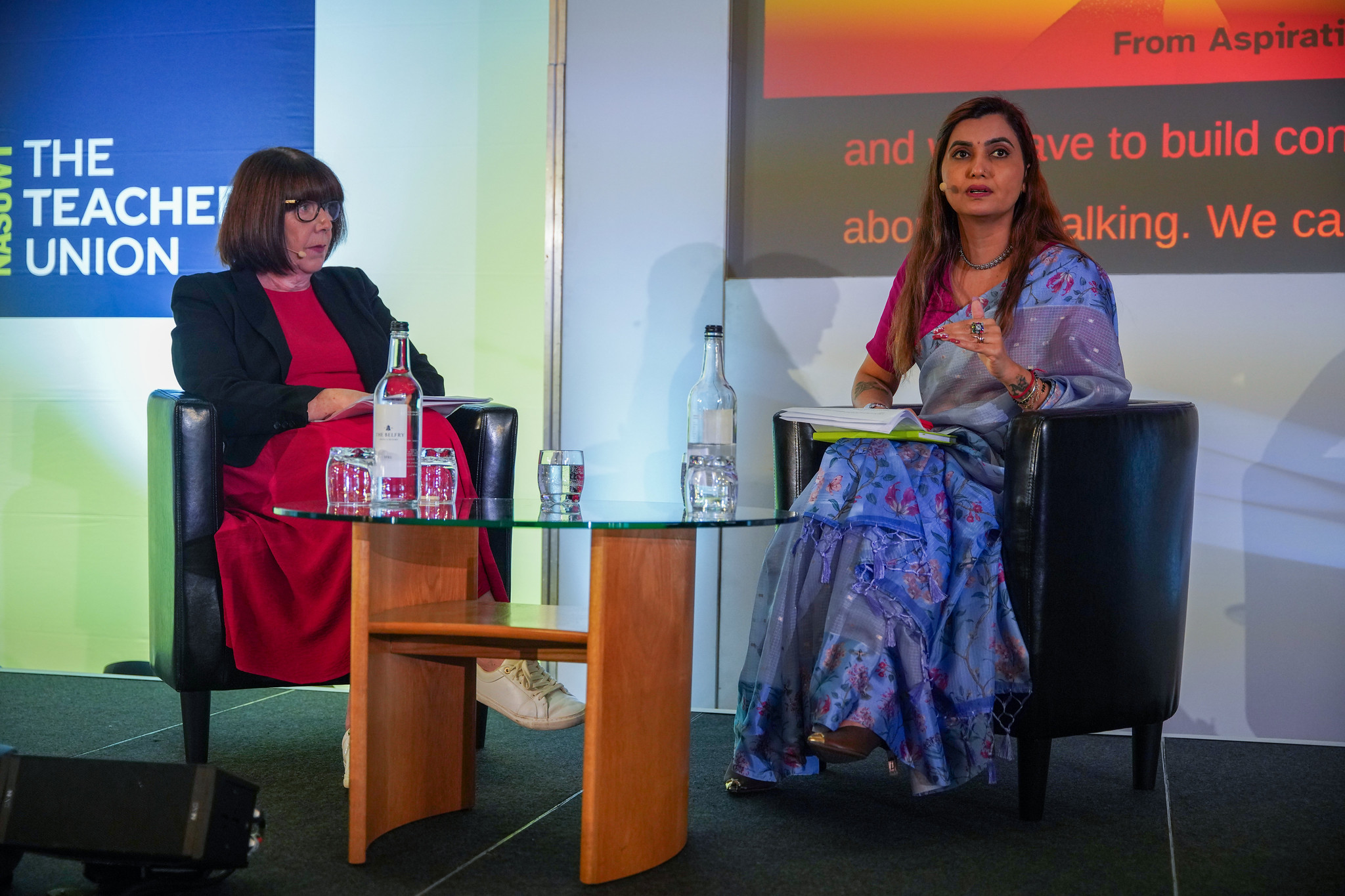
NASUWT Black members took inspiration from a female Indian trade union leader who travelled 8,000 miles by road building activism and fighting for teachers’ pensions.
Dr Seema Mathur, of the All India Primary Teachers' Federation spoke to teachers about her struggles in the union as a women and how she overcame discrimination.
She spoke eloquently about her fight to give the female-dominated teaching profession greater female leadership.
In conversation with NASUWT Deputy General Secretary Jane Peckham at the NASUWT Black Teachers' Consultation Conference, she described entering union meetings where “the stage was fully packed with all the male leaders… all the key posts and all the decision‑making table discussions was being occupied by male leaders only.”
Despite women comprising around 80% of India’s primary teachers, she said female representation in leadership was “one or two percent”.
One of the most inspiring parts of her experience as a trade unionist in India was her 33-day road-trip across the south of India, in which she travelled more than 8,000 miles driving a bus as part of her union’s Bharat Yatra campaign, demanding the re-instatement of pension benefits for all teachers and other government workers.
She explained that four major rallies on national routes across India were planned with each led by male union leaders. She said while women were expected to take part they were not expected to lead.
But Seema refused to accept this: “I begged a post for me that I want to lead one yatra…from the south of India, with almost 13,000 kilometres by road, and for 33 consecutive days,” she said.
Her determination secured her the leadership of one of the national routes which had a lot of success in terms of recruitment and increasing the visibility of her union and the campaign. She added: “This yatra had most participation of teachers, and this yatra brought huge impact towards female leadership,” she told delegates.
Seema’s journey was important because in a patriarchal society it was a demonstration that women can lead mass organising efforts across vast distances and under significant pressure and often scepticism.
Seema has punctured assumptions and stereotypes about women’s capacity to lead trade union movements and campaigns. It is hoped her efforts are also helping younger women teachers and trade unionists to see themselves as organisers and leaders.
She said: “It was not a story of me struggling for my space… it was a story of every female teacher who is struggling for their space.”
Asked how she supports women whose voices have historically been excluded, Mathur stressed that empowerment begins with listening. “The first step is not just speaking to them. The first step is listening… they need to be heard without any kind of judgment.”
But she emphasised that listening alone is not enough. “If we keep on talking… that will not lead to any kind of difference unless we provide some opportunities to them.”
Her reflections echoed themes raised throughout the conference about the importance of Black teachers’ networks, safe spaces and routes into activism.
Mathur described how increasing women’s representation in union leadership had shifted the issues prioritised by the movement. When leadership was overwhelmingly male, negotiations focused on pay and career progression, while gender‑specific concerns were sidelined.
Women leaders had brought workplace safety, maternity rights, menstrual leave and respect at work into mainstream campaigning.
She highlighted successful efforts to secure equal maternity leave for contractual teachers. “Motherhood is the right of every teacher, whether she is on contract or she is a permanent teacher,” she said.
Mathur also described campaigns for menstrual leave across Indian states, including Karnataka, Kerala, Jharkhand and Bihar. “Four states have approved that leave… and if we keep on fighting someday uniformly India will adopt it.”
She also spoke candidly about violence against women and girls in India, describing a recent attempted rape in Delhi where authorities responded by restricting women’s access to public spaces rather than concentrating on catching the perpertrators.
She reflected on the personal cost of her activism, including long periods away from her husband and children.
She emphasised the importance of investing in younger activists and highlighted progress within her own association, including the appointment of a woman General Secretary.
Ms Peckham praised Mathur’s “extraordinary commitment” and reaffirmed NASUWT’s dedication to international solidarity through Education International.
The conversation reminded NASUWT members of the shared experiences between women educators in India and Black teachers in the UK such as underrepresentation, discrimination, barriers to leadership and the need for collective action.
It reinforced a central message that runs through the NASUWT’s national and international work - that lasting change begins when those experiencing discrimination are empowered to speak, organise and lead.
The Conference held a wide range of workshops and panel sessions in areas including health, approaches to diversity, equality and inclusion, safeguarding and protecting Black boys, organising through the NASUWT's Fix Our Future, Fund Education campaign and the role of NASUWT Black Teacher Networks in building solidarity and developing activists.