
This report provides the findings from the annual survey of supply teachers in Wales and highlights the experiences of supply teachers during the academic year 2024/25
Introduction
Nature of work
Access to work
Availability of work
Experiences of supply teachers when undertaking work in schools
Experiences with schools, staff, parents and pupils when undertaking assignments
Provision of key information when undertaking assignments
Access to facilities and amenities in schools when undertaking assignments
Issues and concerns, including health and safety, for supply teachers
Rates of pay for supply teachers
Financial situation
Pensions
Training and behaviour management support
The National Supply Pool for Wales
Ways in which the Welsh Government could best support supply teachers
Conclusion
Introduction
Supply teachers are integral to the education system. Without supply teachers, many pupils would be denied the opportunity to be taught by qualified and dedicated teachers who ensure that schools can continue to provide the education to which children and young people are entitled. Supply teachers make a vital contribution to securing high educational standards for all children and young people.
NASUWT’s annual survey of supply teachers in Wales aims to examine the changing experiences of supply teachers, including issues and trends.
The 2024/25 survey was undertaken between July and September.
This report provides the findings from the 2024/25 survey of supply teachers and highlights the experiences of supply teachers during the academic
year 2024/25.
Nature of work
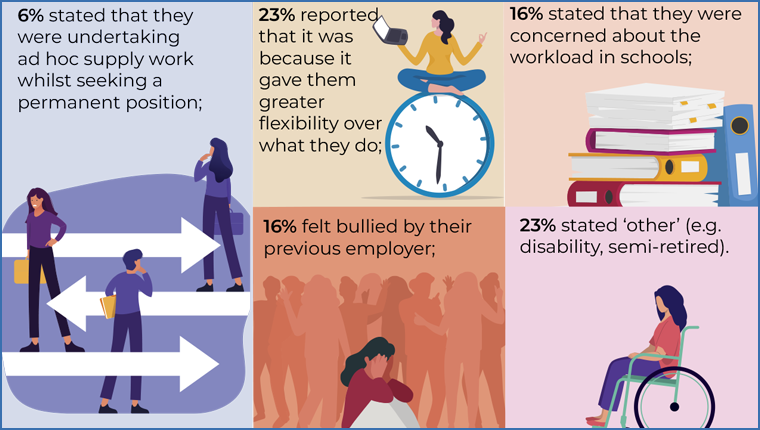
Supply teachers were asked why they carried out supply teaching work. The top five reasons cited by supply teachers were:
Many schools and agencies claim schools only want cover supervisors, then expect people to teach.
When asked what other advantages/disadvantages were associated with being a supply teacher, the top three advantages cited by supply teachers were freedom and flexibility (32%), workload (e.g. no planning/report writing/marking) (26%), and work-life balance (15%). However, the top three disadvantages cited by supply teachers were job/financial insecurity (30%), lack of respect (from both pupils and staff) (15%), and poor rates of pay (13%).
Supply teachers were asked about the ability to secure work teaching during the academic year 2024/25. Over a third (37%) reported that they had no problem securing work, whereas almost two-fifths (39%) reported that they had some problems securing work. However, just over a fifth (22%) of supply teachers reported that they had significant problems getting supply work, and 2% reported that they had not been able to secure any supply work.
Extreme downturn in work during this academic year.
Day-to-day supply has dropped significantly this year, teaching assistants are being used instead, and some schools are doubling up classes.
Access to work
During the academic year 2024/25, just over one in ten (11%) supply teachers reported that they were working for one school, 9% reported that they were working for two schools, 15% reported that they were working for three schools, one in 20 (5%) reported that they were working for four schools, and just over a fifth (21%) reported that they were working for five schools. Just under two-fifths (39%) of supply teachers reported that they were working for more than five schools.
Although I tend to get sent to the same places, I have worked in at least nine schools.
Of those supply teachers who reported that they were able to secure work during the academic year 2024/25, just under three-quarters (73%) of supply teachers said that they had secured work through a supply agency, whilst almost a fifth (19%) reported that they had secured work directly as a supply teacher by a school, and just under one in ten (8%) stated that they had secured work via a local authority supply pool.
For those supply teachers working through an agency during the academic year 2024/25, well in excess of two-fifths (44%) stated that they were signed up to one agency to secure work, a third (33%) reported that they were signed up to two agencies, almost one in ten (9%) reported that they were signed up to three agencies, and another 9% reported that they had signed up to four agencies. One in 20 (5%) reported that they were signed up to five agencies.
For those supply teachers working through a local authority during the academic year 2024/25, almost three-quarters (74%) of supply teachers reported that they were signed up to one local authority, 13% reported that they were signed up to two local authorities, and almost one in ten (9%) reported that they were signed up to three local authorities. Almost one in 20 (4%) stated that they were signed up to four local authorities.
For those supply teachers working directly for a school during the academic year 2024/25, almost two-fifths (39%) stated that they were employed by one school, just under a quarter (23%) stated that they were employed by two schools, and 23% stated that they were employed by three schools. Fifteen per cent stated that they were employed by five schools.
Almost a quarter (24%) of supply teachers stated that this was more than during the previous academic year, whereas 15% reported that this was less, and just over three-fifths (61%) stated that it had stayed the same.
Just under a fifth (18%) of supply teachers reported travelling between 0-10 miles for an assignment, well in excess of a third (36%) reported travelling between 11-20 miles, a quarter (25%) reported travelling between 21-30 miles, just over one in 20 (6%) reported travelling between 31-40 miles for an assignment, and 7% reported travelling between 41-50 miles. Just over one in 20 (6%) supply teachers reported travelling between 61-70 miles, and 1% reported travelling between 81-90 miles.
The wider the net, the greater the possibilities of getting work. However, many agencies dislike this and usually push supply teachers to one side if we work for another agency or don’t work as a cover supervisor, which I always refuse to do.
Just over a fifth (22%) of supply teachers reported that they had to travel further than in previous years in order to secure work.
Three-fifths (60%) of supply teachers stated that the cost-of-living crisis had a detrimental impact on how far they were willing to travel to undertake an assignment.
Availability of work
Supply teachers were asked where they were able to obtain work during the academic year 2024/25.
Just under two-fifths (38%) of supply teachers who responded to the survey stated that their supply work took place in primary schools, a third (33%) stated that their work was in secondary schools, and just under one in ten (8%) reported that their supply work took place in a special school/pupil referral unit (PRU).
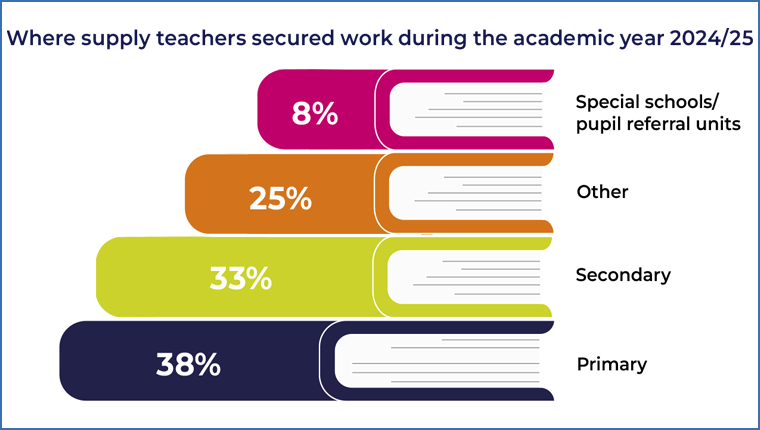
Where supply teachers secured work during the academic year 2024/25
For those supply teachers who reported that they were able to secure work during the academic year 2024/25, two-thirds (66%) reported that the majority of their supply teaching was ad hoc/daily work, well in excess of one in ten (14%) said that this was weekly assignments, and 1% stated that this was monthly assignments. One per cent of supply teachers reported that the majority of their work was termly assignments, and just under a fifth (18%) stated that the majority of their teaching was on longer term assignments in excess of a term.
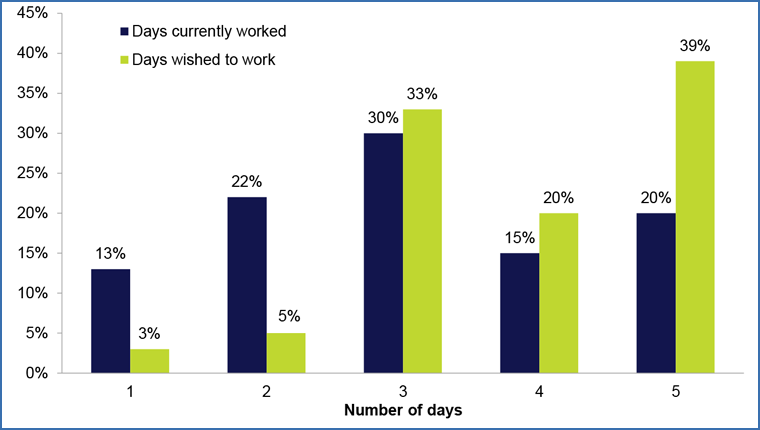
When supply teachers were asked how many days on average they were able to obtain work during the academic year 2024/25, 13% said they obtained work one day a week, just over a fifth (22%) two days a week, and 30% three days a week. Fifteen per cent of supply teachers in the survey said they were able to obtain work for four days a week, and a fifth (20%) stated that they were able to obtain work five days a week. However, over nine out of ten (92%) supply teachers stated that they wanted to work between three to five days a week.
Over half (53%) of supply teachers stated that the amount of supply work had decreased during the academic year 2024/25 compared to the previous academic year, whereas almost one in ten (9%) stated that the amount of supply work had increased. Just under two-fifths (38%) of respondents stated that the opportunities had stayed the same.
I am currently working as a long-term 1:1 teaching assistant as I am frightened I won’t have enough teaching supply in decent schools to cover my bills.
Schools are cutting back due to budget cuts and using internal cover supervisors. Some schools employ us supply teachers as cover supervisors, despite us teaching all day.
Experiences of supply teachers when undertaking work in schools
Supply teachers were asked about their experiences when working during the academic year 2024/25.
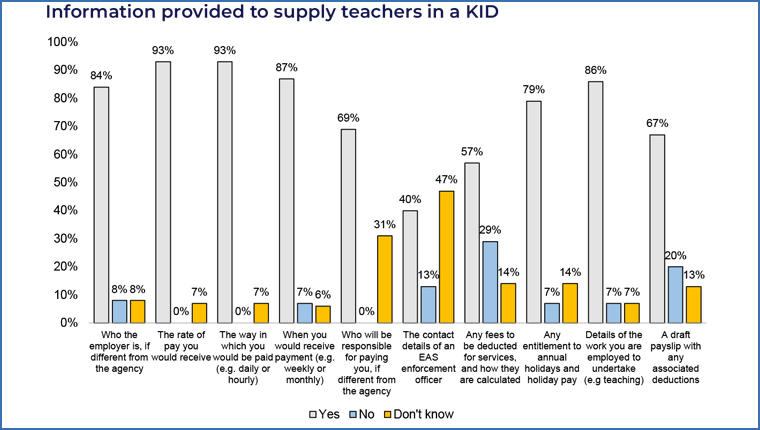
Despite it being a legal requirement since April 2020, just under a third (32%) of supply teachers who obtained work through a new supply agency reported that they had been provided with a Key Information Document (KID), detailing how they would be paid and associated deductions, as well as other key details, and well in excess of two-fifths (46%) stated that they did not know whether or not they had been provided with a KID by the agency.
Just over one in 20 (6%) supply teachers stated that they had been asked to undertake a ‘free trial’ by an agency at a school prior to undertaking paid work.
I signed up with CoverStaff (via Eteach) and they offered me this [‘free trial’]. I turned it down and have not heard from them since. They were quite pushy and rude.
Fifteen per cent of supply teachers stated that work had been cancelled on specific longer term assignments at, or approaching, the 12 weeks’ qualification period for the Agency Workers Regulations (AWR).
Just over three-fifths (62%) of supply teachers reported that an agency had suddenly and unexpectedly terminated a booking in the last 12 months.
Experiences with schools, staff, parents and pupils when undertaking assignments
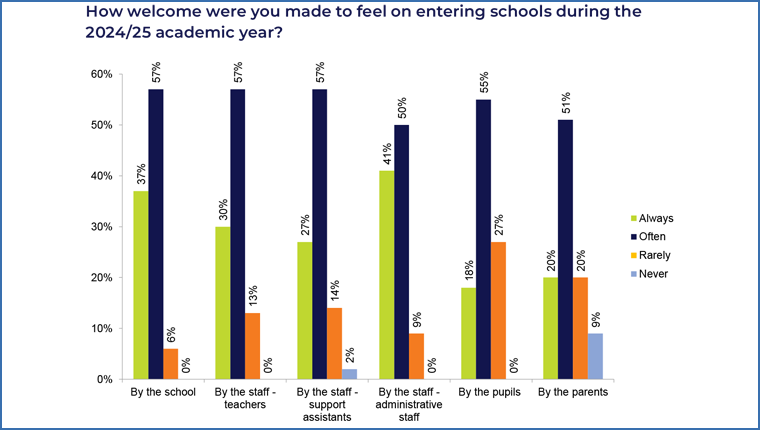
Under two-fifths (37%) of supply teachers reported that they are always made to feel welcome by the school, and under three-fifths (57%) stated that they are often made to feel welcome by the school. However, just over one in 20 (6%) said that they are rarely made to feel welcome by the school.
When asked how welcome they are made to feel by the teaching staff in schools, 30% of supply teachers reported that they are always made to feel welcome, and under three-fifths (57%) reported that they are often made to feel welcome by the teaching staff in schools. However, over one in ten (13%) supply teachers stated that they are rarely made to feel welcome by the teaching staff in schools.
When asked how welcome they are made to feel by the support assistants in schools, just over a quarter (27%) of supply teachers reported that they are always made to feel welcome, and under three-fifths (57%) reported that they are often made to feel welcome by the support assistants in schools.
However, 14% of supply teachers stated that they are rarely made to feel welcome by support assistants in schools, and 2% stated that they are never made to feel welcome by support assistants in schools.
If you complain about a teaching assistant treating you badly or undermining you, which has happened constantly, you either risk losing work or do lose work there.
When asked how welcome they are made to feel by the administrative staff in in schools, just over two-fifths (41%) of supply teachers reported that they are always made to feel welcome, and half (50%) reported that they are often made to feel welcome by the administrative staff in schools. However, almost one in ten (9%) reported that they are rarely made to feel welcome by the administrative staff in schools.
When asked how welcome they are made to feel by the pupils in schools, just under a fifth (18%) of supply teachers reported that they are always made to feel welcome, and 55% reported that they are often made to feel welcome by pupils in schools. However, just over a quarter (27%) of supply teachers reported that they are rarely made to feel welcome by the pupils.
In respect of being made to feel welcome by the parents, a fifth (20%) of supply teachers stated that they are always made to feel welcome by the parents, and just over half (51%) reported that they are often made to feel welcome by the parents. However, a fifth (20%) of supply teachers reported that they are rarely made to feel welcome by the parents, and almost one in ten (9%) stated that they are never made to feel welcome by the parents.
Just over a third (34%) of supply teachers reported that they had experienced physical abuse or violence from pupils when undertaking an assignment, and just over two-thirds (67%) stated that they had experienced verbal abuse or violence from pupils when undertaking an assignment.
Just under nine out of ten (89%) supply teachers indicated that they had reported the incident/s to someone in the school; however, of those who did report the incident, just under a fifth (18%) stated that no action was taken against the pupil, and well in excess of two-fifths (44%) stated that they didn’t know or were not informed whether or not any action was taken.
Most schools dealt well with these incidents. I always report problems because pupils respond better if they view you as being engaged with the school structure.
One school in particular could not be bothered to back me up. A two-week booking was ended without explanation.
Provision of key information when undertaking assignments
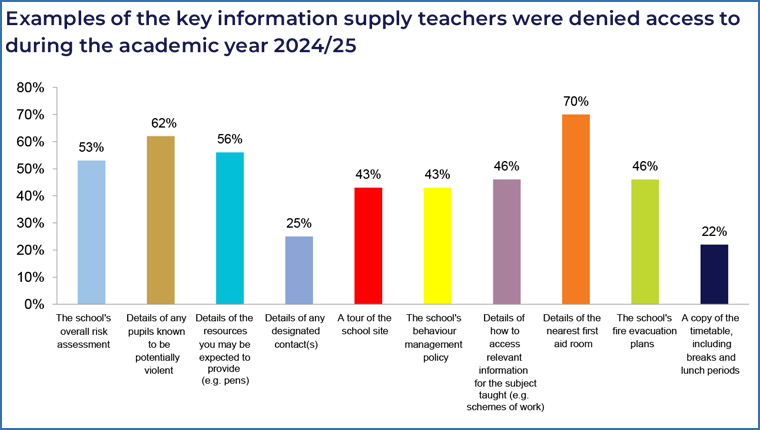
Of those supply teachers able to secure work during the 2024/25 academic year, over half (53%) stated that they were not given the school’s overall risk assessment, and 15% stated that they were not sure.
Under two-fifths (37%) of supply teachers stated that they were not given the arrangements in place for supply teachers to report safely to the workplace, and 7% of supply teachers reported that they were not given the details of who and where to report to each day, including details of the signing-in process.
Seventy per cent of supply teachers stated that they were not provided with the details regarding access to, and availability of, hand sanitiser, and just over two-thirds (68%) reported that they were not provided with the details in place to ensure classrooms and work areas were well ventilated.
A quarter (25%) of supply teachers stated that they were not provided with the details of any designated contact(s) for any questions, problems or emergencies.
Just under two-fifths (38%) of supply teachers reported that they were not provided with the details of how to raise any concerns about health and safety, and just over two-fifths (41%) reported that they were not provided with the details of how to call for assistance, including first aid. Furthermore, seven out of ten (70%) supply teachers reported that they were not provided with the details of the nearest first aid room or appropriate area.
In regards to the school’s fire evacuation plans, including routes and procedures, 46% of supply teachers reported that this was not provided to them when undertaking assignments in schools during the 2024/25 academic year.
In excess of two-fifths (43%) of supply teachers stated that they had not been given a tour of the school site, including identifying where they would be teaching when undertaking assignments in schools.
In respect to the timetable, including breaks and lunch periods, as well as expectations on staff during such times, just over a fifth (22%) of supply teachers reported that information regarding this had not been provided to them when undertaking assignments in schools.
Just under two-fifths (38%) of respondents reported that they had not been provided with the details of the registration process and expectations for the appropriate movement of pupils around the school site between lessons, at breaks, and at lunchtimes, and at the end of the school day when undertaking assignments during the 2024/25 academic year.
In regards to teaching, 46% of supply teachers reported that they were not provided with details of how to access relevant information on schemes of work for the subjects they were expected to teach, and 45% reported that they had not been provided with access to relevant teaching materials.
In the long-term placement, I received all of the above; however, in the short-term - day-to-day placements - I received very little information regarding the schools.
In addition, well in excess of a quarter (29%) of supply teachers stated that they were not provided with the details regarding access to computers, with log-in details and what to do at the end of the school day, and well over half (56%) reported that they were not provided with the details of any resources they might reasonably be expected to provide to students, such as pens.
Three-fifths (60%) of respondents stated that they were not provided with a list of the pupils in the class(es) they would be teaching, including details of any medical conditions, behavioural issues or special educational needs and disabilities (SEND), and just over three-fifths (62%) of supply teachers stated that they had not been provided with the details of any pupils known to be potentially violent, and how this should be managed.
Furthermore, over two-fifths (43%) of supply teachers reported that they had not been provided with the behaviour management policy when undertaking assignments in schools, including who to contact.
Fifty-five per cent of supply teachers reported that they had not been provided with the details of any events, meetings or specific activities taking place, and well in excess of half (54%) of supply teachers stated that they had not been provided with the arrangements for school transport, as appropriate, when undertaking assignments during the 2024/25 academic year.
Many don’t have log-in details when all the work is set on Google Classroom. I have to wait for the arrival of a teaching assistant to give me log-in details. This makes me late to know the details of the day. This is annoying when I arrive early to be well prepared.
Access to facilities and amenities in schools when undertaking assignments
When asked about access to facilities and amenities when undertaking assignments in schools during the 2024/25 academic year, well in excess of half (54%) of supply teachers stated that they do not always have access to staff rooms where they were available, over four-fifths (83%) stated that they do not always have access to staff food and drink facilities, and just over a fifth (22%) said that they do not always have access to toilet/washroom facilities. Over three-fifths (63%) of supply teachers reported that they do not always have access to car parking.
When asked about the assignments undertaken during the academic year 2024/25, well in excess of two-fifths (46%) of supply teachers reported that they had access to a designated contact person all of the time, whereas 29% reported having access to a designated contact person some of the time. A quarter (25%) of supply teachers reported that they did not have access to a designated contact person.
83% of supply teachers stated that they do not always have access to staff food and drink facilities when undertaking assignments
I am treated in the same manner as a permanent member of staff.
Issues and concerns, including health and safety, for supply teachers
A third (33%) of supply teachers stated that they do not feel that any issues and concerns they have raised are taken seriously, and 17% stated that they didn’t know.
Some attitudes are that when there is a ‘supply’, pupils feel disrupted and can’t cope.
Just over half (52%) of supply teachers who secured work during the academic year 2024/25 stated that they were concerned about their health and safety when undertaking supply work in schools, and one in ten (10%) thought that they may have been penalised or had work cancelled for disclosing personal information about their health and safety (e.g. pregnant).
Rates of pay for supply teachers
In respect of rates of pay, supply teachers who were able to secure work through an agency/agencies on the National Procurement Service (NPS) were asked if they had been paid in line with at least the equivalent rate of M2 (£166.33) for the academic year 2024/25.
Just over three-quarters (76%) of supply teachers reported that they had been paid in line with at least the equivalent rate of M2, whereas 16% stated that this was not the case.
Sometimes I was, but quite often I am told it will be on a cover supervisor rate as it all a school can offer. But they basically hire us on the cheap.
£180 per day, including holiday pay.
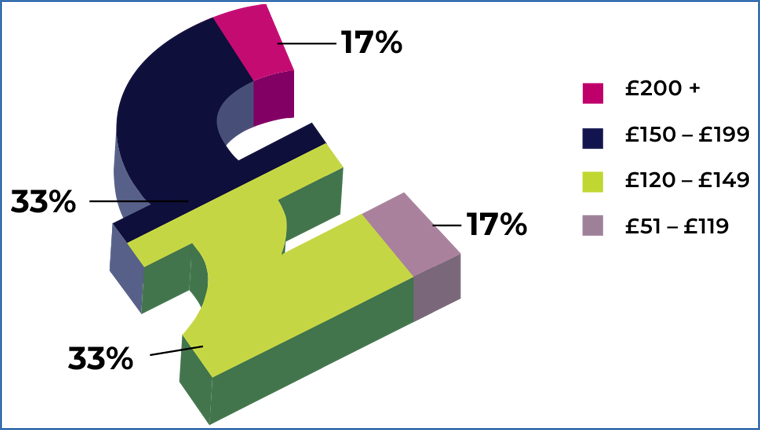
For those supply teachers who were not paid in line with the arrangements set by the NPS for the academic year 2024/25, 17% stated that they were paid at between £51 and £119 per day for assignments, a third (33%) stated that they were paid at between £120 and £149 a day, and another 33% stated that they were paid at between £150 and £199 a day for assignments.
Seventeen per cent of supply teachers stated that they were paid £200 or more per day for assignments.
Just over two-fifths (42%) of supply teachers indicated that the rates of pay received during the academic year 2024/25 were the same as those they were able to earn in the previous academic year, whereas almost a fifth (19%) reported that the rates of pay received were less than those they were able to earn in the previous academic year. Almost two-fifths (39%) said that the rates of pay received were more than those they were able to earn in the previous academic year.
When asked if the agency/agencies where they undertook work during the academic year 2024/25 operated a ceiling in respect of their remuneration, in excess of two-fifths (43%) of supply teachers reported that the agency/ agencies did.
It is sealed at £166 per day, even though I have UPS3 experience.
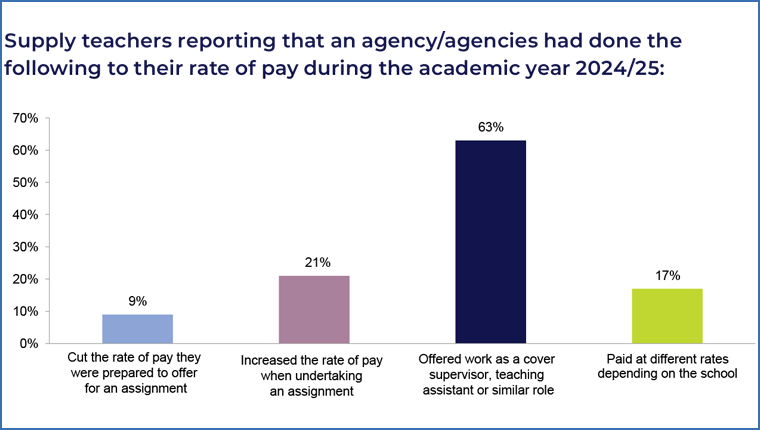
Just 17% of supply teachers stated that they were able to negotiate or secure an increase in their daily rate with an agency/agencies when undertaking an assignment during the 2024/25 academic year
16% of supply teachers stated that they were able to secure more money when working through a local authority or directly with a school in comparison to supply work through an agency
Financial situation
Supply teachers were asked about their financial situation during the academic year 2024/25.
Over two-fifths (43%) of supply teachers reported that they had sourced work elsewhere other than teaching during the academic year 2024/25. Of those, in excess of four-fifths (84%) stated that the work sourced elsewhere other than teaching failed to provide the same level of financial income that they would have obtained had they been able to secure work teaching.
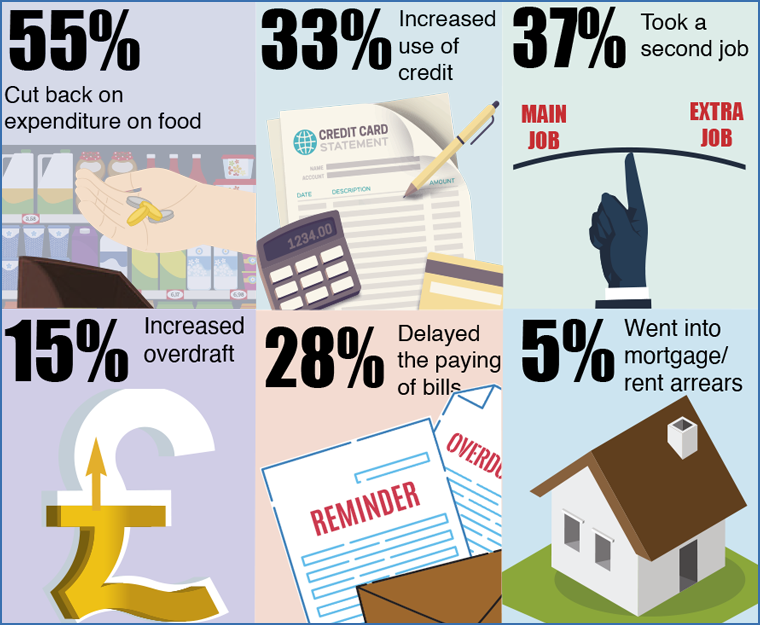
Almost a fifth (19%) of supply teachers reported having to claim some form of state benefit during the academic year 2024/25 (e.g. Universal Credit), and 58% stated that they had experienced financial hardship as a supply teacher over the same period.
58% stated that they had experienced financial hardship as a supply teacher
Almost our out of five (78%) supply teachers who responded stated that undertaking supply work and the inability to secure a permanent post had affected their ability to make significant life decisions
Borrow from family, use ALL of my savings.
I rarely put my heating on during the winter, as I try to live within my earnings. I eat simply and shop in charity shops. I have looked at alternative work but am too old to start something new.
Pensions
Whilst the legislation prevents supply teachers working for a supply agency from paying into the Teachers’ Pension Scheme (TPS), just over four-fifths (82%) stated that they are still members of the TPS. Of these, just over a quarter (26%) reported that they were active members, almost two-fifths (39%) reported that they were deferred members, and just under a fifth (18%) reported that they were drawing a pension.
Of those supply teachers who indicated that they were not members of the TPS, 29% reported that they did not have any alternative pension scheme provision.
I am in NEST - they are awful and nowhere near as good as the TPS in terms of cumulative pension.
The scheme is offered through NEST which is nowhere near as good as TPS. It would be great to be able to continue adding to my TPS while on supply.
Training and behaviour management support
Two-fifths (40%) of supply teachers stated that they had not been given access to continuing professional development (CPD) in the last 12 months.
For those supply teachers who had access to CPD, the primary sources of training were obtained via a supply agency (83%), funded personally (14%), from their trade union (14%), or the schools at which they worked (12%).
40% of supply teachers stated that they had not been given access to CPD
In regards to participating in in-service training (INSET) days provided by schools during the 2024/25 academic year, just over one 20 (6%) supply teachers reported that they were asked to participate in all the INSET days in schools where they undertook assignments, whereas just over one in ten (12%) reported that the a few of the schools asked them to participate in INSET days.
Just over four-fifths (82%) of supply teachers reported that they were not asked to participate in any INSET days provided by the schools where they undertook assignments.
School I am on long-term placement in refused to allow me CPD on INSET days. Previous schools have encouraged and allowed this.
The National Supply Pool for Wales
Just over a third (35%) of supply teachers stated that they were not aware that the Welsh Government had abandoned the National Supply Pool for Wales, and just over one in 20 (6%) did not know.
When asked how they felt about the decision by the Welsh Government to abandon plans for a National Supply Pool for Wales, almost seven out of ten (69%) supply teachers either disagreed or strongly disagreed with the decision by the Welsh Government.
A national supply pool would have enabled us to access a higher rate of pay and possibly allowed us to be back in the TPS.
Just under half (48%) of supply teachers reported that they did not feel they are treated with respect and dignity
This year has been disappointing. I have loved being on supply since I left a permanent job in 2020, but I am now having to look for an alternative as schools are struggling with budgets and so are covering more internally - making any financial planning too difficult.
Not at all, you feel like a pawn used to fill a gap. You are given basic information and yet you constantly deal with the unknown, thinking on your feet. The cover work left is very poor and insufficient. You are not given access to class charts to reward or sanction students - so you are left feeling vulnerable. And, in addition, now you are hired for less pay! Schools could not function without our work.
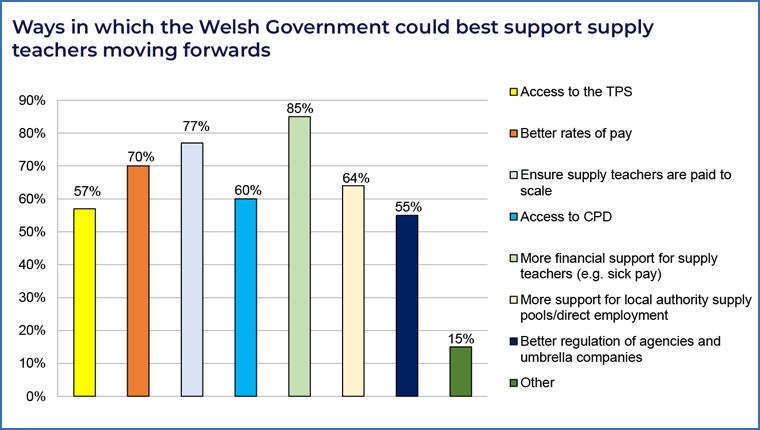
Ways in which the Welsh Government could best support supply teachers
Conclusion
The survey of supply teachers emphasises the continuing critical role that supply teachers have played in maintaining educational provision in schools in Wales during the 2024/25 academic year.
However, the survey suggests that the experiences of supply teachers throughout the 2024/25 academic year have been varied, with a notable increase in those supply teachers reporting significant problems securing work and more being offered alternative roles, such as cover supervisors instead (often on lower rates of pay). Disappointingly, it appears that more supply teachers are being expected to undertake a ‘free trial’ prior to securing work.
The availability and nature of the work supply teachers in Wales have been able to access have also altered, with an increase in those working in short-term ad-hoc daily assignments as opposed to longer term assignments, though it appears that more of this is being secured directly with schools and/or local authority pooled supply arrangements.
Given this, it is not unsurprising to note that there has been an increase in those supply teachers who report signing up with more agencies or schools and local authorities to secure work, as well as an increase in those having to travel further afield to undertake assignments as a supply teacher.
On the critical issue of pay, it is concerning to note the decline in those supply teachers who are able to access more as a daily rate, with the vast majority of supply teachers still only able to access rates of pay between £51-£149 per day when undertaking an assignment. This is compounded by the fact that some supply teachers are reporting less ability to negotiate increases in pay in comparison to previous years as more agencies look to operate a ceiling in relation to this.
As a consequence, it remains the case that a significant proportion of supply teachers are paid at rates that are not commensurate with their level of experience and expertise. Indeed, many experienced and qualified teachers find themselves on rates of pay that have not changed in years, with some daily rates received when undertaking supply work being lower than the rates of pay for an unqualified teacher.
Given this, it is disappointing, but not surprising, to note that some supply teachers still find themselves in the position of having to make tough decisions about their expenditure, including an increased number reporting that they have had to delay the paying of bills or been forced into mortgage/ rent arrears.
It is pleasing to note that the 2024/25 survey indicates that many school communities are far more welcoming to supply teachers, with a marked increase in those reporting that they are often made to feel welcome by the school, the staff, and particularly by the pupils.
Despite this, the 2024/25 survey indicates that there has been an increase in the number of supply teachers reporting that schools are routinely failing to provide key information when undertaking assignments, specifically in regards to critical health and safety information, such a tour of the school site, the fire evacuation plans, and details of the pupils in the classes that they would be teaching, including any associated medical conditions, behavioural issues or Additional Learning Needs (ALN); all of which are vital for supply teaches to be able to safely discharge their duties.
It therefore comes as no surprise that there has been an increase in those supply teachers reporting that they were concerned about their health and safety, coupled with a decline in the number of supply teachers stating that they are treated with respect and dignity.
There are concerns that these disparities in treatment are impacting disproportionately on women, Black and minority ethnic (BME) groups and disabled teachers, who are more likely to be employed as supply teachers.
In this context, the results from the 2024/25 survey substantiate the pressing need for a Better Deal for Supply Teachers that addresses the systematic flaws in the current system and recognises and values the important and significant contribution they make to the education system in Wales.
The full survey report can be downloaded on the right/below.