
What is the role of risk assessments in supporting neuro-inclusive workplaces?
Legal framework
Health and Safety at Work etc. Act 1974
This is the overriding piece of health and safety legislation that underpins the whole health and safety system in the United Kingdom.
The most important duty it imposes on employers is to do everything reasonably practicable to ensure the health, safety and welfare of their employees.
Management of Health and Safety at Work Regulations 1999
These regulations build on the 1974 Act and formally introduced the concept of risk assessment, essentially requiring all foreseeable hazards to be risk assessed.
Equality Act 2010
The most relevant part of this Act in the current context is that a person is disabled if they have a physical or mental impairment that has a ‘substantial’ and ‘long-term’ negative effect on their ability to carry out normal day-to-day activities.
‘Substantial’ means more than minor or trivial, while ‘long-term’ typically means it has lasted or is likely to last at least 12 months.
In addition, they require that where someone has a disability, then the employer has a duty to put in place reasonable adjustments.
These form the legislative basis for neuro-inclusive risk assessment duties.
What is a risk assessment?
-
A risk assessment is a process to identify hazards, evaluate likelihood and severity of harm, and take steps to minimise or eliminate risks.
-
Employers must protect people ‘as far as reasonably practicable’ - not eliminate all risk.
-
A hazard is anything with the potential to cause harm (physical or mental), whilst a risk relates to the likelihood that a hazard causes harm.
Employer responsibilities
Employers:
-
should conduct general and individual risk assessments setting out what the hazards and risks are and the control measures that they intend to put in place to mitigate the hazards.
NASUWT has a Risk Assessment Toolkit which explains the process in more detail.
-
must consult staff on the risk assessment. This includes:
-
NASUWT Representatives;
-
staff generally;
-
individuals concerned.
-
The risk assessment should be amended on the basis of consultation, where necessary.
-
should share outcomes with relevant staff - there is no point undertaking a risk assessment if it is not shared.
-
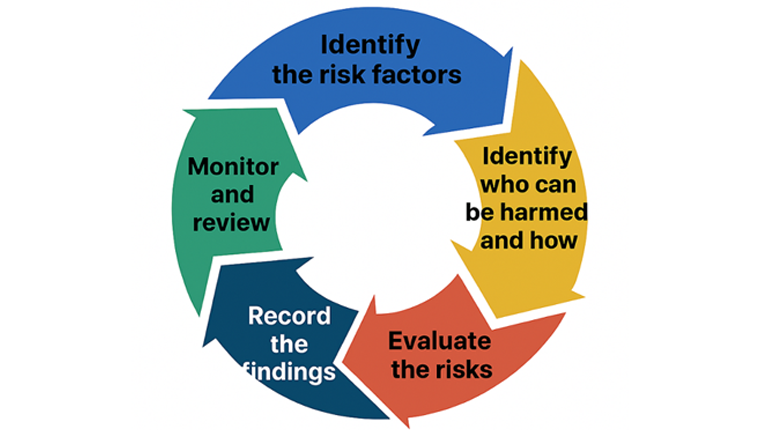
should monitor and review:
-
periodically;
-
after incidents;
-
when new information emerges.
-
Risk assessment is a continuous cycle, as demonstrated in the image below:
Possible hazards for neurodivergent teachers
Mental and emotional health
-
Burnout, exhaustion.
-
Anxiety, depression.
-
Increased suicide risk.
-
Low self-esteem.
-
Substance misuse.
Physical safety
-
Higher risk of accidents.
-
Sensory overload.
-
Decreased interoception. [1]
Institutional hazards
-
Social isolation.
-
Discrimination.
Stress risk assessments, general and individual, are relevant here. NASUWT has specific guidance on stress risk assessments on our Mental Health and Work-related Stress Toolkit page.
Individual risk assessments - staff
Individual risk assessments:
-
are not always necessary, but individuals should be able to request one. It will depend on the circumstances and should be approached on a case-by-case basis;
-
should involve consultation with the individual, being very much a ‘done with’ process, not a ‘done to’;
-
should focus on hazards/triggers and controls;
-
may include training for staff/managers, which could also include general awareness training;
-
should consider reasonable adjustments;
-
consider confidentiality - while possible, it may limit effectiveness as risk assessments should be shared with relevant staff;
-
should be regularly reviewed by agreement.
Individual risk assessments - pupils
-
again, these are not always necessary, but may form part of a support plan. It may also be requested by parents;
-
may be triggered by specific risks, e.g. violence;
-
should be undertaken using the same process, including, consultation, sharing, review, and monitoring.
NASUWT Representative role
Promote a neurodiversity staff policy that includes:
-
a clear definition of neurodiversity;
-
an inclusive approach;
-
examples of strengths and employment challenges;
-
approach to reasonable adjustments, possibly with examples;
-
training requirements, e.g. awareness;
-
links to relevant documents/policies and resources.
Footnote
[1] Interoception is the collection of senses providing information about the internal state of the body.