

Introduction
The NASUWT Being a Teacher and Parent Survey was undertaken between November and December 2025.
A total of 2,164 teachers responded to the survey, of which 94% reported that they had dependent children.
The survey takes a look at the experiences of being a parent and a teacher, five years on from the previous survey of NASUWT members conducted back in 2020, to see if the realities faced by teachers who are parents have changed or if the attitude and approach towards their needs and demands remains a cause for concern.
Disappointingly, the 2025 Being a Parent and Teacher Survey shows that five years on the dial has not shifted, with far too many teachers reporting significant challenges in juggling the demands of teaching with the responsibilities of being a parent.
The profound and lasting impact teachers have in shaping the personal development, academic success and future aspirations of other parents’ children all too often comes at a high price in terms of time spent with their own children, with far too many teachers missing out on opportunities to witness key moments in the lives of their children.
The survey shows that governments and schools and colleges need to act to tackle the workload and excessive hours that teachers work, whilst at the same time implementing fit-for-purpose and family-friendly policies that enable teachers to be parents and better manage the demands of teaching with that of a family.
Now, more than ever, governments need to act to stem the crisis in teacher recruitment and retention and prevent it from becoming an epidemic.
As such, the Union is calling for:
-
a day-one right for 52 weeks of fully paid occupational maternity leave for both permanently employed and supply teachers working across governments and administrations throughout the UK, with a view to adapting this over time to become 52 weeks of fully paid parental leave, e.g. paternity leave, adoption leave etc.;
-
the portability of maternity and parental rights, e.g. paternity, adoption leave etc., across all employers;
-
well-paid financial support to enable fathers/co-parents/partners to spend significant time as primary carers for their children in the early years; and
-
all teachers having the option of flexible working to improve work-life balance and retention.
The survey
Almost three-fifths (58%) of teachers who responded to the survey stated that they were classroom teachers. Just under a third (32%) stated that they were middle managers or head of year/TLR holders. Just over one in 20 (6%) stated that they were a member of the senior leadership team and 2% stated that they were a headteacher.
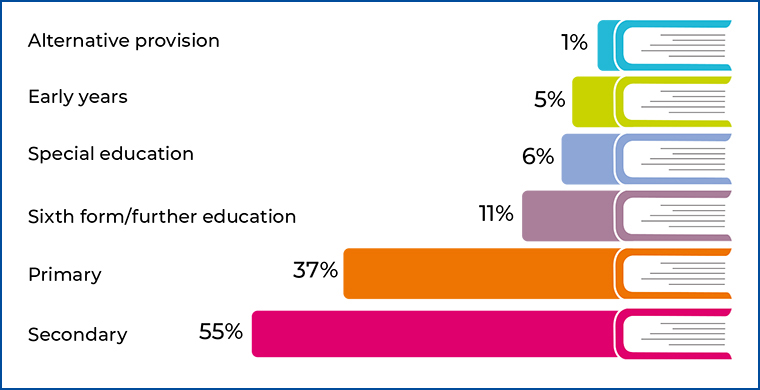
Where teachers who were parents undertook their work
Of those teachers who responded, well over half (55%) reported that they worked in a secondary school, compared to just under two-fifths (37%) who reported working in a primary school. Just over one in ten (11%) reported working in sixth-form/further education and 6% reported working in special education. One in 20 (5%) reported working in early years and just 1% reported working in alternative provision, e.g. pupil referral units.
Family-related leave and pregnancy
Teachers were asked about their experiences of family-related leave and pregnancy, including maternity leave, paternity leave, adoption leave, parental leave and shared parental leave.
Of those teachers who had taken family-related leave in the last five years, just over two-thirds (67%) reported that they had taken maternity leave, 17% had taken paternity leave, and 2% had taken adoption leave. However, just over one in ten (11%) had taken parental leave and just 3% stated that they had taken shared parental leave.
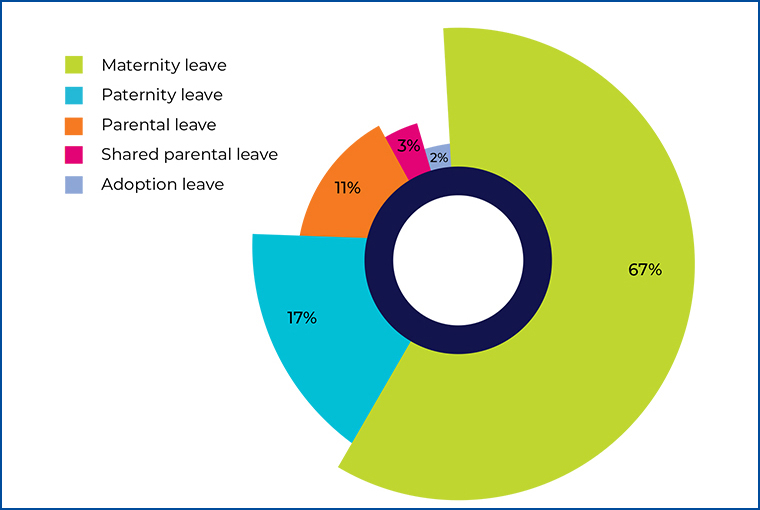
Types of family-related leave taken in the last five years by teachers
Just over one in ten teachers (11%) reported taking two weeks of maternity/paternity/adoption leave and just under one in ten (8%) reported taking maternity/paternity/adoption leave of between one to five months. One in ten teachers (10%) took six months of maternity/paternity/adoption leave, whereas over two-fifths (43%) of teachers took between seven to 11 months of maternity/paternity/adoption leave. Over a quarter (28%) of teachers took a year for maternity/paternity/adoption leave.
Just over three-quarters (77%) of teachers stated that they would have liked to take more time off for maternity/paternity/adoption leave.
Maternity pay meant a huge hole in our earnings, forcing me back into work before I or my child was ready.
More time off for dads - women need the support of their partners. Mothers are drained physically and emotionally. Partners need time to properly bond with their own children.
Couldn’t actually take paternity leave because we couldn’t afford to only have £150 per week coming in for that period.
Currently, teachers’ maternity pay rates are now years behind other sectors.
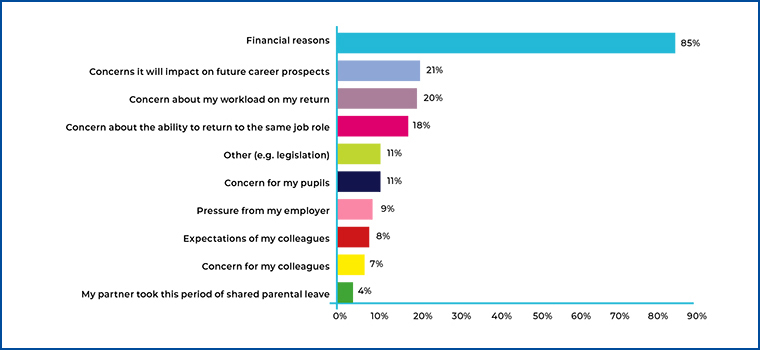
Reasons given by teachers as to why they did not take additional maternity/ paternity/adoption leave
The maternity pay is abysmal and insulting. I am very upset I cannot spend my baby’s first year with her as I can’t afford to and it would be detrimental to my career prospects.
Systems should be put in place to allow parents to have time to bond with their babies, as psychological research into attachment shows this is best for all involved.
In regards to employers keeping teachers informed of important information while they are on maternity/paternity/adoption leave, such as job vacancies and/or redundancies, just under two-thirds (64%) of teachers reported that their employer did not keep them informed, whereas well over a third (36%) reported that their employer did keep them informed.
My job changed whilst I was on maternity leave. They restructured the pastoral team and interviewed staff for head of year roles. I was not told about this - nobody contacted me. I saw an email after that stated who had been appointed.
Just over three-quarters (77%) of respondents reported that they had requested time off from their employer to attend antenatal appointments with their partner. Of those, well in excess of four-fifths (86%) responded that this was paid time off, whereas 7% responded that this was unpaid time off. However, just over one in 20 (7%) stated that their request for time off to attend antenatal appointments with their partner was refused.
It was questioned why I had to attend antenatal appointments and that I had to consider the impact on cover at the school. As a result, it felt awkward and I did not attend some appointments.
When asked about the response of the employer to their pregnancy/pregnancies, just over half (51%) felt that their employer had not adequately assessed and addressed any workplace-related risks associated with their pregnancy.
I was given a walkie-talkie to call for cover when I needed the toilet. Before becoming pregnant, I taught in classrooms all over the school. When pregnant, the students came to me.
For my second pregnancy, a risk assessment wasn’t even completed. I also suffered with quite bad sickness and asked if something could be put in place if I needed to leave class to be sick. I was told ‘no’. There was a couple of occasions where I used a bucket in the cupboard in the classroom.
In addition, well in excess of two-fifths (46%) of respondents who experienced pregnancy stated that their employer had not discussed and produced an individual risk assessment with them.
For those respondents who experienced pregnancy who did have an individual risk assessment discussed and produced with them, just over two-thirds (67%) stated that this was not reviewed with them on a regular basis, including in the third trimester.
In regards to pregnancy-related illness, just under two-fifths (38%) of respondents stated that they had taken time off work due to pregnancy-related illness and over a quarter (28%) reported that they had felt pressure from their employer to return to work before they were well enough to do so.
While I was off sick due to pregnancy-related issues, my employer was not very understanding. Even though I had been signed off, I was regularly contacted and felt pressured about work, which added unnecessary stress at a time when I should have been focusing on my health.
I had to have minor surgery whilst pregnant. Was made to feel guilty taking time off. Had to leave work on three occasions as I was bleeding. Was suggested by headteacher that I was overreacting. It turned out I had an abnormal growth on my cervix.
Teachers who were off with pregnancy-related illness were asked if they had been asked to undertake activities by their employer whilst they were off work. Of those who responded:
-
well in excess of four-fifths (85%) stated that they were asked to set work for their classes/plan lessons;
-
just over a fifth (21%) stated that they were asked to mark work;
-
just over a quarter (27%) stated that they were asked to write reports;
-
one in ten (10%) stated that they were asked to attend meetings; and
-
just over one in ten (12%) stated that they were asked to do ‘other activities’, e.g. oversee an exam or respond to emails.
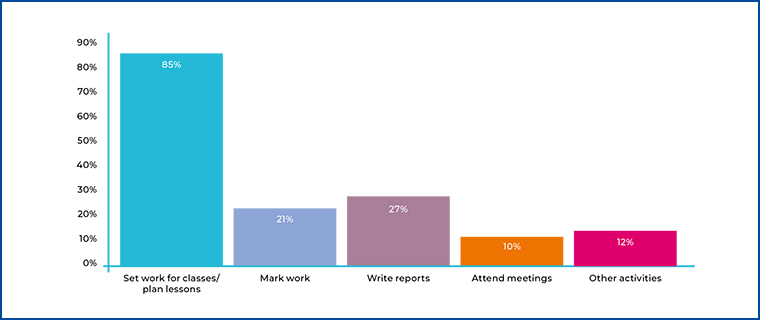
Activities that teachers were asked to undertake when off due to pregnancy-related illness
Despite the fact that employers are obliged to record pregnancy-related sickness absence separately and discount this for the purpose of sickness absence, just under a fifth (18%) of respondents reported that their employer counted the time off as sickness absence and half (50%) reported that they didn’t know whether or not their employer counted the time off as sickness absence.
When I returned, it was to a full timetable straightaway. I came back to all the assessments that needed marking that the supply teacher had not marked. I suffered postnatal depression. I was not allowed to leave open evening at 7pm instead of 8pm to breastfeed. There was no reintroduction meeting after maternity (even though the school policies had changed).
When I went in for a meeting as a KIT day, they told me I wasn’t going back to the same school, they were keeping my replacement and they were moving me to a different school in the Trust. No further discussion was had and I just had to deal with it.
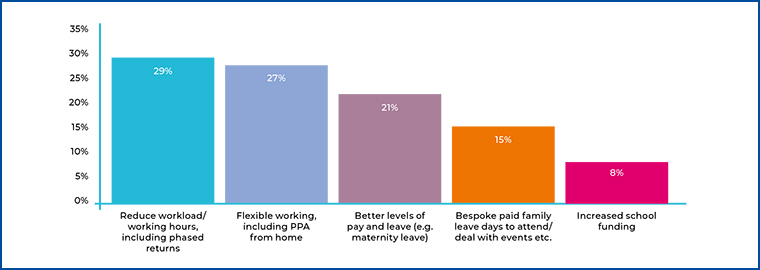
The top five ways in which the Government could best support being a parent and a teacher
Instead of being present, watching a family movie on a Sunday, taking my children swimming, I feel I’m constantly snatching any time I can to try to chip away at my insane workload. I can never switch off and my children feel this. This is why I have decided to actively seek employment elsewhere, despite my 16 years of experience and leadership qualification. If only the Government would support existing and experienced teachers like myself and so many other parent-teachers who have been forced out.
It’s hard and I don’t think I’ll be doing it much longer. I’m looking for different jobs with more flexibility and less mental exhaustion/stress.
I wish I had never gone into teaching.
I’m leaving the profession. I’ll never get back the hours I have given up in free overtime to help other people’s kids whilst my own dealt with ASD, suicidal thoughts and life-limiting medical conditions. Really happy to leave this accursed profession.
I would not encourage anyone to be a teacher and wish I had opted for a different career path. There is a lack of opportunities for progression, no family life balance and no benefits.
There is an irony that being a teacher means you are not always able to actually be a parent to your own child, only everyone else’s.
Balancing responsibilities at work with being a parent
Teachers who are parents were asked about the ability to balance their responsibilities at work with being a parent.
Of those teachers who are parents, almost all respondents (95%) said that they had found it difficult to balance their responsibilities at work with being a parent and 86% felt that they had regularly missed out on important times with their children due to their work commitments.
It is extremely difficult, to the point that the job feels incompatible with being a parent. There is no real support for teacher-parents.
Schools want parental engagement with their child’s education, but school teachers cannot get time off to attend meetings, etc.
I try desperately to make sure that when my children need to talk something through, want some time together or require a lift somewhere, that I am available to them and ‘present’ in the moment. But in doing that, I constantly fight the panic of not having done enough for school or prepared thoroughly enough for lessons.
I feel I am so stretched. I’m neither a good parent nor a good teacher.
I am made to feel guilty about taking time off for my child, not allowed to attend his school events, and have been threatened about leaving parents’ evening before the official end due to lack of childcare.
Having work from school delivered to the hospital for me to complete whilst I was at my child’s bedside holding an oxygen mask over his face was one of the worst moments as a parent and teacher.
Teachers who are parents were asked if their job ever got in the way of them doing certain things relating to their children. Of those who responded:
-
just over four-fifths (82%) stated that their job got in the way of them looking after their children when they are ill;
-
just over three-quarters (77%) stated that their job got in the way of them attending their child’s/children’s school assemblies;
-
a total of 76% stated that their job got in the way of them attending their child’s/children’s sports days;
-
a total of 70% stated that their job got in the way of them attending their child’s/children’s school play;
-
well in excess of two-fifths (46%) stated that their job got in the way of them attending the parents’ consultation meeting for their child/children; and
-
over two-fifths (44%) stated that their job had got in the way of them doing ‘other’ things relating to their children, e.g. sharing quality time in the evening and at weekends, attending appointments, and after-school clubs and activities.
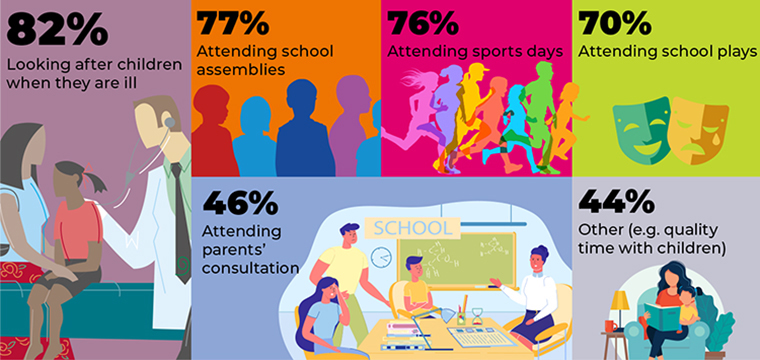
Has teaching ever got in the way of you doing certain things relating to your children?
Playing at the weekend, extracurricular activities.
Picking them up from sporting events, taking them to friends’ houses or having friends over.
My saddest day as a parent was when I came downstairs one morning to find my six-year-old had written a card asking me to please come to her assembly as he was the lead in it. I could not go as the head was unapproachable and I was expected to put my school children first.
Just miss out a lot on booking family days out and being a ‘fun’ mum because I am so exhausted and weighed down with workload. The stress is too much to switch off and my mood can unfortunately reflect this at home.
Teachers who are parents were asked if time spent working outside school hours ever got in the way of their ability to do a range of activities.
Just over nine in ten (92%) reported that time spent working outside school hours got in the way of spending quality time with their child/children at home, just over seven in ten (71%) reported that it got in the way of helping their child/children with their homework. Sixty-two per cent reported that it got in the way of going on family outings/days out, just under a third (31%) reported that it got in the way of doing other activities with their children/children (e.g. after-school activities/clubs, bedtime, playing together, taking them to parties), and almost a quarter (24%) reported that it got in the way of going on family holidays.
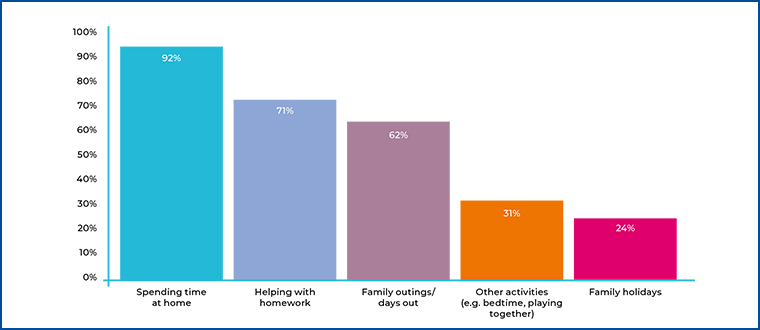
Has work outside school hours got in the way of doing a range of activities?
I often need grandparents to look after the children or take them out, so that I can complete work tasks.
I often have to ask my partner to take my daughter to her swimming and gymnastics lessons, to allow me the quiet time I need to be able try to catch up with the extra workload.
Taking time off work to care for a child or children
Teachers who are parents were asked about their experiences when caring for a child/children and the need to take time off work.
Well in excess of four-fifths (84%) of respondents reported that they had taken time off because their child/children were ill.
In regards to how accommodating the employer was to staff who needed time off when a child was ill, 15% of respondents stated that their employer was very accommodating and three in ten (31%) stated that their employer was quite accommodating. Fifteen per cent of respondents stated that their employer was quite unaccommodating and almost one in ten (8%) teachers stated that their employer was very unaccommodating. Thirty-one per cent of respondents were neutral in relation to this.
I have been asked, ‘Why can’t you get somebody else to look after them?’ in the past. The pay deduction is the biggest issue.
My two-year-old daughter was in hospital for ten days with pneumonia on oxygen. I was expected to send in work each day. It was unpaid. I was expected to answer emails from the head. We then got the Ofsted call and I got a continuous stream of phone calls telling me I had to be in school and the data I was required to produce. I’d been sleeping in the hospital on a crash mat-style bed for ten nights. I ended up going in as it was easier.
My son was in hospital being tested for cancer and she thought I was being unreasonable asking for parents’ evening to be rescheduled.
There is a strong sense of guilt attached to taking time off when your child is unwell. Even when the absence is legitimate, there is subtle pressure, judgement, and the feeling that you are letting everyone down. It never feels safe to prioritise your own child’s wellbeing.
The intensity and inflexibility of my teaching have had a profound impact on my children and our family, to the point where I have seriously considered leaving the profession.
I’m actively seeking jobs out of teaching for a better fit around family life.
Flexible working
Teachers who are parents were asked about their experiences in regards to flexible working in response to their parental responsibilities, including the attitudes of schools and colleges in respect of this.
Almost half (49%) of teachers responded that they had asked their employers for flexible working due to their parental responsibilities.
Of those teachers who made a request for flexible working, just under two-thirds (64%) requested a reduction in their hours, just over one in ten (11%) requested working from home (e.g. PPA time off the school site), almost one in 20 (4%) requested a job share, and just 2% requested compressed hours. Almost a fifth (19%) of respondents requested other types of flexible working, e.g. phased retirement.
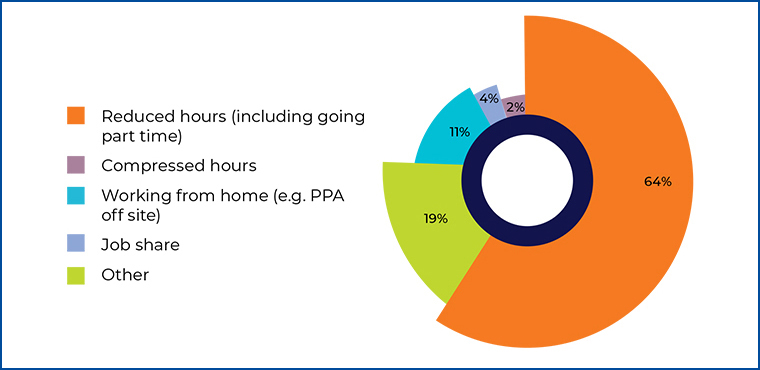
Types of flexible working requested by teachers
We have been told that senior leadership positions cannot be part time as it does not fit the business model. Anyone who has previously requested it has had it declined. They have ended up seeking other employment.
I’ve been told that going part time will mean I can’t apply to move up to UPS as I won’t have enough evidence.
I was given all the bottom sets because I wasn’t in school much.
When a recent management position role became vacant in the school, it was made clear that only full-time applicants would be considered.
Despite it being a legal requirement since April 2024, almost four-fifths (79%) of respondents whose request for flexible working was rejected stated that their employer had not held a ‘consultation meeting’ to discuss the details of their request with them, including any possible alternative arrangements.
Even though the Acas Code of Practice, on requests for flexible working, places an expectation that those holding a ‘consultation meeting’ should have sufficient decision-making powers, almost a quarter (24%) of those whose employers did hold a ‘consultation meeting’ stated that this was not the case and over a third (36%) stated that they didn’t know whether or not this was held by someone who could agree to their request.
Despite the fact that the Acas Code of Practice, on requests for flexible working, provides for the right to be accompanied to a ‘consultation meeting’ by someone, including a trade union representative, just over a quarter (26%) of respondents stated that they were not able to do this and over half (52%) stated that they didn’t know whether or not they had the right to be accompanied, including by a trade union representative.
Furthermore, almost a quarter (24%) of respondents stated that they were not able to have a ‘reasonable’ discussion in the ‘consultation meeting’ that gave their flexible working request ‘serious consideration’ and over two-fifths (43%) stated that they didn’t know whether or not the ‘consultation meeting’ provided for a ‘reasonable discussion’ that gave their flexible working request ‘serious consideration’.
Of those teachers whose request for flexible working was rejected, over two-fifths (43%) stated this was because their employer said it would be too difficult to accommodate, 29% stated it was because their employer said it would be too disruptive to pupils/staff, 14% stated it was because their employer said it would be too difficult to recruit extra staff, and just over one in ten (11%) stated it was because their employer said it would be too expensive. Just under two-fifths (38%) stated ‘other’ reasons, whereas 13% of respondents stated that they were not given a reason why their employer rejected their request to work flexibly.
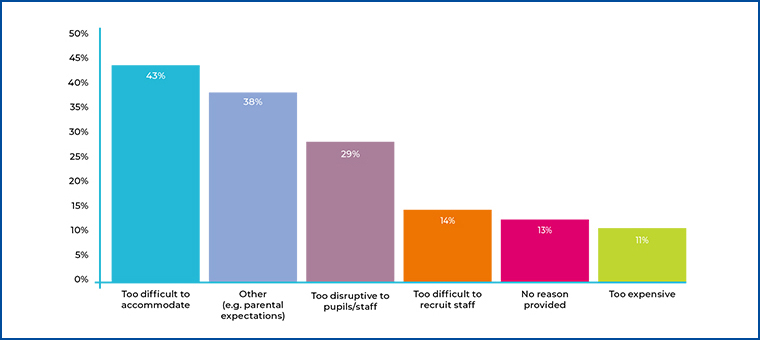
Reasons given to teachers by employers for refusing a request for flexible working
It was against school policy.
No consultation was offered - he just sent me a letter to say it was not granted.
Initial application to get part-time working was not approved. The reason given, ‘we don’t like people working part time.’ Eventually, I was given part-time work.
Advised that parents wouldn’t like it.
My headteacher wants us to do PPA in school so that she can ‘keep an eye on us’.
Just over three-quarters (76%) of teachers reported that they were not given the right to appeal the decision by their employer to reject their request for flexible working, despite this being good practice and recommended in the Acas Code of Practice on requests for flexible working.
Despite changes in April 2024, just over two-thirds (67%) of respondents were not aware that they could submit another flexible working application in any 12-month period and over one in ten (13%) stated that they didn’t know that they could submit another flexible working application in any 12-month period.
Conclusion
The 2025 Being a Parent and Teacher Survey shows that five years on the situation has not changed, with many still reporting significant challenges in accessing more flexible and family-friendly working practices in schools and colleges across the UK.
Whilst many teachers adore their job and the impact they have on the children and young people they teach, it is clear that for far too many this comes at the expense of time spent with their own children, sacrificing key moments in their life to get the job done.
Far too many teachers are still struggling to achieve a satisfactory work-life balance, with many working in the evenings, at weekends and on their days off in order to meet the demands placed upon them by employers. This is totally unacceptable.
Despite changes to legislation in 2024 in an effort to increase the uptake of flexible working, it is clear that many schools and colleges remain stubbornly resistant to the benefits of flexible working amongst the workforce.
The evidence suggests that it is still the case that far too many schools and colleges are failing to agree flexible working requests, specifically part-time working and job share. Of even greater concern is the fact that many schools and colleges are failing to comply with the law by denying teachers the opportunity to have a ‘consultation meeting’ to discuss alternatives. This is totally unacceptable.
Given the tendency for requests for flexible working to disproportionately come from female teachers, this only seeks to reinforce and perpetuate the gender pay and pensions gap and the ‘motherhood penalty’, with some teachers noting the detrimental impact requests for flexible working have on their career progression. This is totally unacceptable.
Disappointingly, far too many women teachers are forced to resign from substantive contracts of employment because schools will not agree to flexible working arrangements and fall into insecure, intermittent and precarious work as supply teachers in order to secure flexible working. This is totally unacceptable.
Despite the fact that leave entitlements for parents are an integral part of the employment landscape, e.g. maternity leave, paternity leave and adoption leave, many parents who are teachers, specifically women during their pregnancy or maternity leave, are being treated negatively or in a discriminatory way, including being dismissed, demoted or harassed by colleagues or managers/senior leaders. This is totally unacceptable.
Furthermore, despite evidence demonstrating the significant positive benefits when partners spend periods caring for young children, feedback suggests that policies designed to help partners take a more active role in childcare, including paternity leave and shared parental leave, are failing to deliver for vast swathes of teachers. This is totally unacceptable.
In this context, the results from the 2025 survey indicate that there is a pressing need for action on the part of governments and schools and colleges to address the concerns of hardworking and dedicated parents who are teachers, so that they are given the freedom and flexibility to better manage the demands of work with that of a family.
It is clear that governments and schools and colleges must act on this and work to change the experiences of hardworking and dedicated teachers through serious targeted actions that produce tangible benefits to address the ongoing situation for parents who are teachers, including:
-
a day-one right for 52 weeks of fully paid occupational maternity leave for both permanently employed and supply teachers working across governments and administrations throughout the UK, with a view to adapting this over time to become 52 weeks of fully paid parental leave, e.g. paternity leave, adoption leave etc.;
-
the portability of maternity and parental rights, e.g. paternity, adoption leave etc., across all employers;
-
well-paid financial support to enable fathers/co-parents/partners to spend significant time as primary carers for their children in the early years; and
-
all teachers having the option of flexible working to improve work-life balance and retention.